


Table of Contents
- What Does a Healthcare Operations Lead Do?
- Core Healthcare Operations Lead Responsibilities (Numbered Breakdown)
- Hard Skills vs. Soft Skills: What the Role Actually Demands
- Healthcare Operations KPIs Every Lead Must Track
- Healthcare Process Improvement Examples from Real Operational Challenges
- Post-Pandemic Shifts That Redefined the Operations Lead Role
- Career Pathing: Roles, Growth, and Job Outlook
- Conclusion
Last Updated: May 11, 2026
Healthcare operations lead responsibilities sit at the intersection of clinical oversight, administrative control, and strategic execution, and most job descriptions dramatically undersell how complex the role actually is. This guide from Medical Management Tutorial covers everything from the numbered breakdown of core duties to the tech stack modern operations leads rely on daily. Below, we’ll show you exactly how the role has evolved post-pandemic, what KPIs actually matter, and why the soft skills are harder to hire for than the technical ones.
Here’s what most guides get wrong: they treat this role as glorified scheduling and budget oversight. The reality is that an operations lead in a healthcare facility is often the single point of accountability when patient flow breaks down, regulatory audits arrive, or a new service line needs standing up in 90 days.
According to the American Hospital Association’s workforce and operations resources, healthcare organizations face compounding pressure from workforce shortages, rising operational costs, and accelerating regulatory requirements, all of which land squarely on the operations lead’s desk.
What Does a Healthcare Operations Lead Do?
A healthcare operations lead is the professional responsible for coordinating the non-clinical and administrative systems that keep a healthcare facility running efficiently, safely, and in regulatory compliance. The role spans staff scheduling, budget management, process improvement, EHR (Electronic Health Records) oversight, and cross-functional leadership across clinical and administrative departments.
This is not a support role. It is a strategic one.
Operations leads own outcomes. They are accountable for patient flow metrics, resource allocation decisions, quality improvement initiatives, and compliance monitoring, often simultaneously. In smaller outpatient centers, one person may carry all of these. In large hospital management contexts, the lead coordinates a team of operational specialists across multiple service lines.
Clinical vs. Non-Clinical Activities: Where the Role Sits
The operations lead role is primarily non-clinical, but it is deeply intertwined with clinical outcomes. Non-clinical activities include staff scheduling, procurement, medical equipment inventory, vendor management, and workflow optimization. Clinical activities, direct patient care, diagnosis, treatment, fall outside the scope.
That said, the boundary is not clean in practice. An operations lead redesigning patient intake workflows directly affects how quickly patients receive care. Decisions about diagnostic facilities layout, telehealth solutions integration, or long-term care staffing ratios all have measurable effects on patient outcomes.
The way I see it, the most effective operations leads are the ones who understand clinical workflows well enough to improve them without overstepping into clinical decision-making.
Healthcare Administration vs. Operations: Key Differences
Healthcare administration focuses on governance, policy, human resources, and organizational structure. Healthcare operations focuses on execution: the day-to-day systems that translate policy into patient experience.
Think of administration as setting the rules and operations as running the game. Both are essential. But the operations lead is the one who gets the call at 6 a.m. when the OR schedule collapses or a compliance audit arrives with 48 hours’ notice.
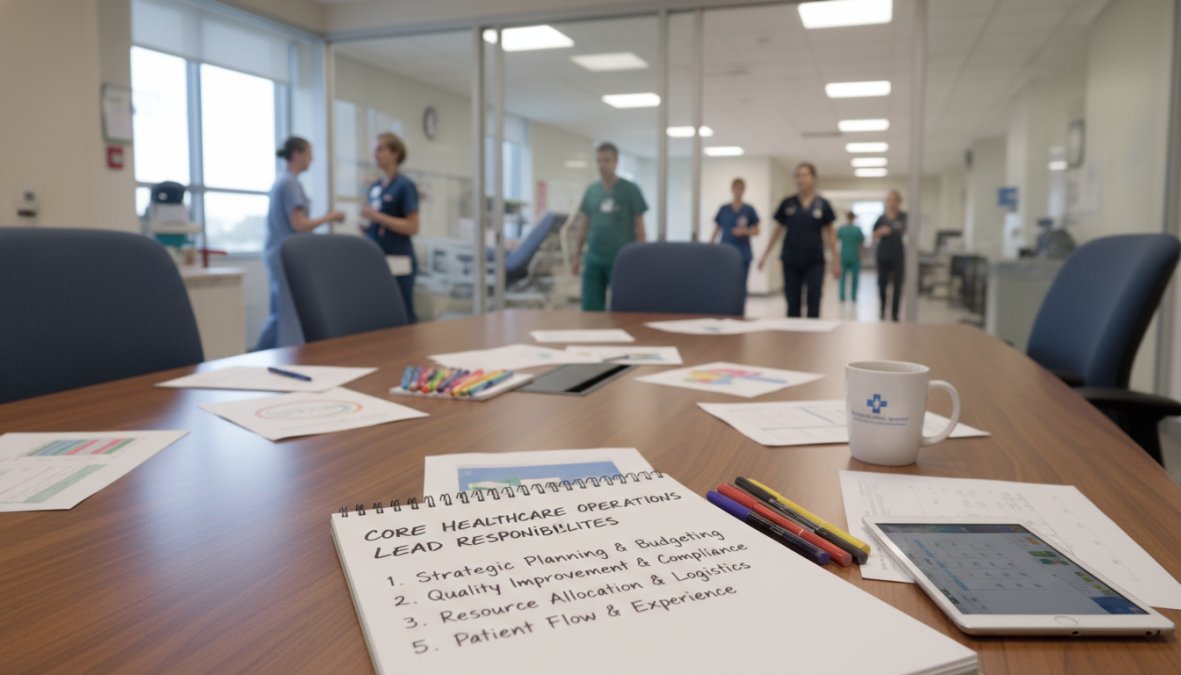
Core Healthcare Operations Lead Responsibilities (Numbered Breakdown)
The numbered breakdown below reflects what the role actually demands across hospital management, outpatient centers, diagnostic facilities, and long-term care environments.
-
Staff scheduling and workforce management, Building and maintaining schedules that align clinical coverage with patient volume, factoring in credentialing requirements, overtime controls, and labor regulations.
-
Budget management and financial oversight, Owning departmental budgets, tracking variances, approving procurement, and reporting to senior leadership on operational spend.
-
Regulatory compliance and risk management, Ensuring the facility meets FDA regulations, ICH/GCP guidelines (particularly relevant in organizations running clinical trials), Joint Commission standards, and state licensing requirements.
-
EHR and health IT coordination, Managing EHR (Electronic Health Records) system configuration, user access, workflow builds, and data integrity in coordination with IT.
-
Patient flow optimization, Analyzing admission, discharge, and transfer patterns to reduce bottlenecks and improve throughput across inpatient and outpatient settings.
-
Quality improvement program leadership, Leading or co-leading quality improvement initiatives, tracking performance against benchmarks, and reporting outcomes to clinical and administrative stakeholders.
-
Resource allocation and medical equipment inventory, Ensuring the right equipment is available, maintained, and compliant with safety standards.
-
Cross-functional leadership and stakeholder management, Coordinating across nursing, physician groups, finance, IT, and external vendors to align operational priorities.
-
Process improvement and workflow optimization, Identifying inefficiencies, designing improved workflows, and managing implementation with frontline staff.
-
Strategic planning support, Contributing operational data and feasibility analysis to service line management decisions and long-term care planning.
Compliance monitoring should be treated as an ongoing operational function, not a pre-audit scramble. Operations leads who build compliance checks into weekly workflows catch issues before they become citations.
Hard Skills vs. Soft Skills: What the Role Actually Demands
Most job postings for operations leads list the hard skills clearly: budget management, EHR proficiency, data-driven decision making, knowledge of regulatory frameworks. Those are table stakes.
The soft skills are where candidates actually differentiate themselves, and where most hiring managers admit they struggle to evaluate.
Hard skills the role requires:
- Financial modeling and budget variance analysis
- EHR system administration (Epic, Oracle Cerner, or athenaOne depending on the environment)
- Working knowledge of FDA regulations and quality management frameworks
- Project management methodology (PMP certification is common but not universal)
- Data analysis and KPI reporting
Soft skills that separate average from exceptional:
- Conflict resolution across clinical and administrative teams with competing priorities
- Change management, the ability to redesign a workflow without triggering staff resistance
- Communication calibration, translating operational data for a CFO versus a charge nurse
- Composure under regulatory scrutiny or operational crisis
- Influence without authority, particularly when working with physician groups
A common mistake is hiring purely on hard skills and discovering six months later that the person cannot hold a room when a department head pushes back on a process change. Healthcare delivery depends on trust, and trust is built through soft skills.
The Tech Stack: Software Tools Operations Leads Use Daily
The modern healthcare operations tech stack has expanded significantly. Operations leads in 2026 are expected to work across multiple platforms simultaneously.
| Platform | Primary Use | Best For |
|---|---|---|
| Epic Systems | EHR, revenue cycle, scheduling | Large health networks |
| Oracle Cerner Millennium | Clinical and financial data integration | Academic medical centers |
| symplr Operations | Workforce, credentialing, compliance | Enterprise health systems |
| QGenda ProviderCloud | Physician and nurse scheduling | Multi-specialty scheduling |
| LeanTaaS iQueue | OR and bed capacity management | High-volume hospitals |
| Workday for Healthcare | HR, finance, supply chain | Back-office modernization |
| ShiftWizard by HealthStream | Staff self-scheduling | Nursing departments |
| SafetyCulture | Audits, compliance checklists, asset tracking | Facility and safety teams |
Epic Systems serves as the digital backbone in most large healthcare systems, handling everything from clinical documentation to revenue cycle management. For operations leads, the most critical Epic skills are analytics module navigation, scheduling workflow configuration, and MyChart patient engagement tools.
LeanTaaS iQueue is worth calling out specifically: its AI-driven block scheduling for operating rooms addresses one of the highest-cost inefficiencies in hospital management. Operations leads who can work with predictive analytics tools like iQueue are increasingly sought after.
Avoid selecting a scheduling platform that doesn’t integrate with your EHR. Disconnected systems create manual reconciliation work that compounds across every shift, every week. The administrative burden alone can offset any scheduling efficiency gains.
Healthcare Operations KPIs Every Lead Must Track
Healthcare operations KPIs are the quantitative measures that reveal whether a facility’s operational systems are functioning at an acceptable standard. Tracking the right metrics is what separates reactive management from genuine operational leadership.
The following KPIs appear consistently across hospital management, outpatient centers, and long-term care settings:
Patient flow metrics:
- Average length of stay (ALOS)
- Bed occupancy rate
- Emergency department door-to-provider time
- Discharge before noon rate
Workforce and scheduling metrics:
- Overtime hours as a percentage of total hours worked
- Staff-to-patient ratios by unit
- Unfilled shift rate
- Credential compliance rate
Financial and operational metrics:
- Cost per patient day
- Supply expense as a percentage of net revenue
- Budget variance by department
- Denial rate on claims (directly tied to EHR workflow quality)
Quality and compliance metrics:
- Adverse event rate
- Readmission rates within 30 days
- Regulatory audit findings per quarter
- Patient satisfaction scores (HCAHPS in inpatient settings)
According to the Centers for Medicare and Medicaid Services quality measures framework, many of these metrics are tied directly to reimbursement rates, which means poor operational performance has direct financial consequences beyond the clinical impact.
Operations leads who build automated dashboards for these KPIs, rather than compiling them manually each month, free up significant capacity for strategic planning work.
Healthcare Process Improvement Examples from Real Operational Challenges
Process improvement in healthcare operations rarely starts with a blank whiteboard. It starts with a problem that has been tolerated for too long.
Here are representative examples of the types of challenges operations leads address and how they approach them:
Challenge: ED overcrowding and boarding
A common approach is mapping the full patient journey from triage to discharge, identifying where handoffs break down. Operations leads often find that the bottleneck is not ED capacity itself but delayed inpatient bed assignments. The fix typically involves redesigning the bed management workflow and creating escalation protocols when boarding exceeds a defined threshold.
Challenge: OR schedule inefficiency
Many facilities lose significant OR revenue to late starts, cancellations, and underutilized block time. Operations leads using AI-driven tools like LeanTaaS iQueue can analyze historical use patterns and reallocate block time to higher-volume surgeons. The process improvement is data-driven, not political, which is what makes it defensible to department heads.
Challenge: Compliance documentation gaps
Teams that build compliance checklists into daily workflows using tools like SafetyCulture tend to see fewer audit findings than those that rely on periodic manual reviews. The process improvement here is structural: moving compliance from a reactive to a continuous activity.
Challenge: Telehealth integration post-expansion
Post-pandemic telehealth solutions created new workflow gaps in scheduling, consent documentation, and EHR documentation. Operations leads who mapped the telehealth patient journey end-to-end and rebuilt intake workflows accordingly reduced no-show rates and documentation errors.
The most effective healthcare process improvement examples share a common structure: define the measurable problem, map the current state, identify the highest-impact intervention point, and pilot before scaling. Skipping the pilot phase is the most common reason process changes fail at scale.
Post-Pandemic Shifts That Redefined the Operations Lead Role
The pandemic did not just stress-test healthcare operations, it permanently restructured what the role demands.

Before 2020, telehealth solutions were a peripheral concern for most operations leads. By 2022, they were a core operational infrastructure. Operations leads who had never managed a virtual care workflow were suddenly responsible for credentialing telehealth providers, configuring EHR documentation for remote visits, and tracking telehealth-specific patient outcomes.
The workforce dimension shifted equally. Staffing shortages across nursing and allied health created sustained pressure on staff scheduling systems, forced rapid adoption of float pool models, and required operations leads to become proficient in demand forecasting tools like ShiftWizard by HealthStream.
As documented in McKinsey’s analysis of post-pandemic healthcare workforce trends, health systems that invested in flexible workforce management infrastructure during the pandemic recovered operational efficiency faster than those that relied on traditional staffing models.
Three structural changes that now define the role:
- Hybrid care model management, Operations leads now coordinate patient flow across physical and virtual care settings simultaneously.
- Accelerated data-driven decision making, Real-time dashboards and predictive analytics moved from "nice to have" to operational standard.
- Expanded risk management scope, Supply chain resilience, infection control protocols, and business continuity planning became permanent operational responsibilities rather than emergency responses.
The operations lead of 2026 is a materially different role than the one described in pre-pandemic job postings. Candidates who present experience navigating these shifts have a clear advantage.
Career Pathing: Roles, Growth, and Job Outlook
Healthcare operations as a career path offers genuine upward mobility, with clear progression from coordinator-level roles to executive leadership.
Typical progression:
- Operations Coordinator / Analyst
- Operations Lead / Operations Manager
- Director of Operations
- VP of Operations or Chief Operating Officer (COO)
The operations lead position sits in the middle of this ladder, senior enough to own outcomes, junior enough to still be hands-on with systems and workflows. It is the role where most operational leaders develop their management identity.
Lateral moves are also common. Operations leads frequently transition into:
- Healthcare administration (policy-focused roles)
- Clinical project activities management (particularly in organizations running clinical trials)
- Service line management (owning a specific specialty’s full operational footprint)
The job outlook for healthcare operations roles remains strong. As the U.S. Bureau of Labor Statistics Occupational Outlook Handbook for medical and health services managers indicates, demand for health services managers is projected to grow significantly faster than the average for all occupations, driven by an aging population and expanding healthcare delivery infrastructure.
Typical Salary Ranges and Job Description Expectations
Salary for a healthcare operations lead varies considerably by facility type, geography, and scope of responsibility. Outpatient centers and diagnostic facilities typically offer lower compensation than large hospital management environments.
A useful framework for evaluating a job description:
- Scope signals: Does the JD list budget authority? If yes, the role carries real financial accountability. If not, it may be a coordinator role with an inflated title.
- Reporting line: Operations leads who report to a COO or VP of Operations have more strategic influence than those reporting to a department director.
- Tech stack requirements: JDs that specify EHR platforms, analytics tools, or scheduling software signal a more operationally mature environment.
- Compliance language: Roles that reference FDA regulations, ICH/GCP guidelines, or Joint Commission standards typically involve higher complexity and higher compensation.
Medical Management Tutorial’s practice management resources cover the administrative competencies that translate directly into operations lead job description requirements, including workflow optimization, patient flow improvement, and billing process management, all areas that appear consistently across operations lead postings at both ambulatory and inpatient facilities.
The most competitive candidates in 2026 combine a clinical understanding with business acumen, technology proficiency, and a demonstrated track record of process improvement. A master’s degree in healthcare administration or business administration is common but not universally required; demonstrated outcomes often carry more weight.
When evaluating a job description, look for whether the role has a defined budget authority threshold. Operations leads with P&L responsibility develop financial acumen faster and are promoted to director-level roles more quickly than those in purely process-focused positions.
Healthcare operations leadership is one of the most demanding and consequential roles in any facility, and most professionals enter it without a structured development path. Medical Management Tutorial addresses that gap directly, offering comprehensive resources on administrative efficiency, patient flow improvement, workflow optimization, and billing process management, the exact competencies that define high-performing operations leads. Get started with Medical Management Tutorial and build the operational foundation that supports both clinical excellence and sustainable practice growth.
Frequently Asked Questions
What is the role of a healthcare operations lead?
A healthcare operations lead oversees the day-to-day non-clinical and administrative functions of a healthcare facility. Their core healthcare operations lead responsibilities include staff scheduling, budget management, regulatory compliance, workflow optimization, and cross-functional leadership. They act as the bridge between clinical teams and executive leadership, ensuring that patient flow, resource allocation, and operational efficiency align with the organization's strategic planning goals.
What skills are needed for healthcare operations management?
Effective healthcare operations management requires a blend of hard and soft skills. Hard skills include proficiency with EHR systems like Epic or Oracle Cerner, data-driven decision making, budget management, and knowledge of FDA regulations and ICH/GCP guidelines for facilities running clinical trials. Soft skills are equally critical: cross-functional leadership, stakeholder management, and the ability to drive process improvement and quality improvement initiatives without disrupting clinical operations.
What are the most important healthcare operations KPIs a lead should track?
Key healthcare operations KPIs typically include patient flow metrics such as average wait times and bed occupancy rates, staff scheduling efficiency, budget variance, regulatory compliance scores, and EHR adoption rates. For outpatient centers and diagnostic facilities, appointment no-show rates and revenue cycle turnaround times are also critical. Tracking these KPIs consistently enables data-driven decision making and helps identify areas for targeted process improvement before they affect patient outcomes.
How does a healthcare operations lead improve patient outcomes?
While a healthcare operations lead focuses on non-clinical activities, their work directly supports better patient outcomes. By optimizing patient flow, reducing administrative bottlenecks, ensuring medical equipment inventory is maintained, and keeping staff scheduling aligned with patient demand, they reduce delays in care delivery. Implementing telehealth solutions and improving workflow optimization also shortens response times and increases access to care across the healthcare facility.
What are some real healthcare process improvement examples an operations lead drives?
Common healthcare process improvement examples include redesigning patient intake workflows to cut check-in times, implementing automated staff scheduling tools to reduce overtime costs, deploying digital compliance checklists to streamline audits, and using capacity management platforms to reduce operating room idle time. Another practical example is standardizing EHR documentation templates across departments, which reduces clinical errors and speeds up billing cycles, directly strengthening the revenue process.