


Table of Contents
- Why Effective Healthcare Staff Handoff Procedures Define Patient Safety
- SBAR Handoff Report Examples: How to Use the Framework Correctly
- Healthcare Handoff Best Practices Every Care Team Should Follow
- Handoff Communication Tools in Healthcare: What Actually Works
- Nurse Handoff Report Length: Finding the Right Balance
- Implementing Effective Healthcare Staff Handoff Procedures by Setting
- Measuring Handoff Effectiveness: KPIs and Quality Improvement
- Conclusion
Last Updated: May 8, 2026
Poor handoff communication is widely recognized as one of the leading contributors to preventable patient harm in hospital settings worldwide. Effective healthcare staff handoff procedures are the structured processes by which clinical authority, responsibility, and critical patient information transfer from one provider to another. This guide from Medical Management Tutorial covers every layer of the topic: the frameworks, the legal stakes, the communication tools, and how to measure whether your handoffs are actually working. Below, we’ll show you exactly how to build a handoff system that protects patients and holds up under regulatory scrutiny.
The gap between knowing handoffs matter and actually fixing them is where most care teams get stuck. Most guides stop at defining SBAR. This one goes further.
Why Effective Healthcare Staff Handoff Procedures Define Patient Safety
A handoff failure is not simply a communication lapse. It is a breakdown in the transfer of accountability, and the consequences range from delayed treatment to serious adverse events. Healthcare providers who treat handoffs as informal verbal summaries are taking on significant, often invisible risk.
The Joint Commission has consistently identified communication failures during transitions of care as a root cause of sentinel events. That finding has held across years of data, across specialties, and across care settings. The problem is structural, not individual.
What makes handoffs uniquely dangerous is the ambiguity they create. When a receiving nurse or physician is unclear about a patient‘s current condition, active treatment plan, or pending results, they are forced to make decisions with incomplete information. Ambiguity at handoff time is where errors are born.
The most common handoff mistake is treating the process as a one-way information dump. If the receiving provider cannot ask clarifying questions and get clear answers, the handoff has not actually occurred. Accountability has not transferred.
The Real Cost of Poor Information Transfer
Poor information transfer at change of shift or unit transfer creates cascading problems. Medication reconciliation errors surface hours later. Critical information about a patient’s deteriorating condition gets lost between providers. Treatment plans get duplicated or abandoned.
The operational cost is also real. Repeated calls back to the outgoing provider, delayed discharges, and redundant assessments all consume time that care teams cannot afford. Structured handoff tools reduce these callbacks significantly, according to quality improvement literature from acute care units.
A common mistake is assuming that longer handoffs are more thorough. In practice, unstructured long handoffs produce more noise than signal. The receiving provider retains less, not more.
Legal and Regulatory Implications of Handoff Failures
From a risk management perspective, handoff documentation is one of the first things plaintiff attorneys examine after an adverse event. If the medical record shows no structured handoff note, or if the electronic health record contains conflicting information about who held clinical authority at a given moment, liability exposure increases substantially.
The Joint Commission’s National Patient Safety Goals include explicit requirements around handoff communication, including the use of a standardized method and opportunities for two-way communication. Accreditation surveys now routinely assess handoff processes directly. Facilities that cannot demonstrate a consistent, documented approach face findings that affect their accreditation status.
Beyond accreditation, state licensing boards and CMS conditions of participation increasingly reference transition of care standards. The regulatory environment around handoffs has tightened considerably, and that trend will continue through 2026 and beyond.
SBAR Handoff Report Examples: How to Use the Framework Correctly
SBAR is a structured handoff tool that organizes clinical communication into four components: Situation, Background, Assessment, and Recommendation. It gives nurses and physicians a shared mental model for what information to transfer and in what order, which reduces ambiguity and shortens handoff time without sacrificing completeness.
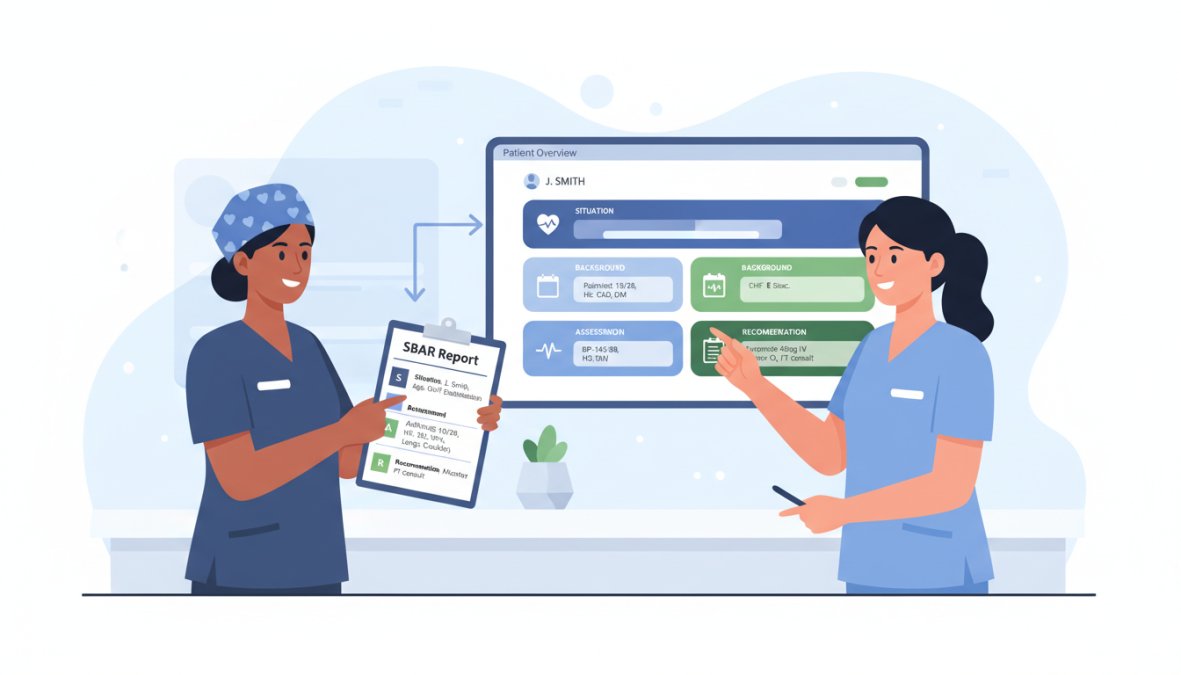
A basic SBAR example for a change-of-shift handoff might look like this:
- Situation: “Mr. Torres in room 412 is a 67-year-old post-op day two following right hip replacement. He’s been reporting pain at 7/10 despite scheduled analgesics.”
- Background: “He has a history of chronic kidney disease stage 3, which limits our NSAID options. His surgical team adjusted his pain protocol this afternoon.”
- Assessment: “I’m concerned his pain is undertreated and he may be guarding, which is slowing his mobility progress.”
- Recommendation: “I’d like you to reassess his pain within the first hour and loop in the surgical team if he’s still above 6/10.”
That’s a complete, actionable handoff. The receiving nurse knows the patient’s current condition, the relevant clinical history, the outgoing nurse’s clinical judgment, and a specific next step.
Write your SBAR before the handoff conversation, not during it. Providers who prepare their report in advance give more accurate, complete information and finish handoffs faster than those who reconstruct information on the fly.
SBAR vs. SBAR+2 vs. I-PASS: Choosing the Right Structure
The original SBAR framework works well for most nurse-to-nurse handoffs. Two expanded frameworks address its limitations in more complex transitions.
SBAR+2 adds two elements: Safety concerns and Synthesis. The Safety component surfaces issues like fall risk, isolation precautions, or pending critical labs. Synthesis asks the outgoing provider to summarize their overall read of the patient’s trajectory. This addition is particularly useful for high-acuity patients where the standard four elements leave important context on the table.
I-PASS (Illness severity, Patient summary, Action list, Situation awareness and contingency planning, Synthesis by receiver) was developed primarily for physician handoffs, particularly in residency training programs. Its defining feature is the synthesis step, where the receiving provider verbally summarizes what they’ve heard. This built-in read-back dramatically reduces errors from misunderstood information. According to I-PASS patient safety program research, programs implementing I-PASS have seen meaningful reductions in preventable adverse events.
| Framework | Best For | Key Differentiator |
|---|---|---|
| SBAR | Nurse-to-nurse, rapid handoffs | Simplicity, speed |
| SBAR+2 | High-acuity patients | Safety flag, synthesis step |
| I-PASS | Physician handoffs, residency programs | Receiver read-back built in |
Choose the framework that matches your care setting and team. Implementing the most complex structure in a low-acuity unit creates friction without adding safety value.
Healthcare Handoff Best Practices Every Care Team Should Follow
The research on handoff communication tools in healthcare points consistently toward a few core practices that separate effective transitions from ineffective ones. These are not suggestions. They are the floor.
Warm Handoffs and Two-Way Communication
A warm handoff is a direct, real-time introduction between the outgoing and receiving provider, often in the presence of the patient. It is the single most effective way to ensure accountability transfers cleanly. The outgoing provider doesn’t just send information; they confirm the receiving provider has it and understands it.
Two-way communication is what separates a handoff from a monologue. The receiving provider must have a genuine opportunity to ask clarifying questions before the outgoing provider leaves. Structured tools like I-PASS build this in explicitly. For teams using SBAR, the clarifying questions step needs to be a deliberate, protected part of the process.
What most guides miss is that the physical environment matters. Handoffs conducted in noisy hallways, with interruptions, produce worse information retention than those conducted in a designated space. If your unit doesn’t have a quiet handoff area, that’s a systems problem worth solving.
Involving Patients and Families in the Transition of Care
Patient and family involvement in handoffs remains one of the most underused practices in hospital settings. Bedside handoffs, where the outgoing and receiving providers conduct the report at the patient’s bedside, give patients the opportunity to correct errors in real time. They hear their own plan of care. They can flag discrepancies.
The concern most teams raise is privacy. That concern is legitimate but manageable. Providers can complete sensitive portions of the handoff outside the room and conduct the patient-facing portion at the bedside. The operational adjustment is small. The safety benefit is significant.
Families, particularly for pediatric patients or patients with cognitive impairment, often hold critical information that doesn’t appear in the electronic health record. A patient’s spouse may know about a medication the patient forgot to mention. A parent may have noticed a change in their child’s condition overnight. Structured handoffs that include a family check-in capture this information systematically.
Bedside handoffs with patient involvement are one of the highest-use changes a unit can make. They cost nothing to implement and directly reduce errors from inaccurate medical records.
Handoff Communication Tools in Healthcare: What Actually Works
Handoff communication tools in healthcare fall into two broad categories: structured verbal frameworks (SBAR, I-PASS, TeamSTEPPS) and technology-based documentation systems. The most effective implementations use both, with the verbal framework guiding what gets communicated and the technology ensuring it gets documented.
TeamSTEPPS, developed by the Agency for Healthcare Research and Quality, provides a broader curriculum for team communication that includes handoff training as a core component. It’s particularly useful for organizations that want to build handoff competency across multiple roles simultaneously, rather than training nurses and physicians separately. According to TeamSTEPPS resources and implementation guides, the program includes specific modules on handoff communication and transition of care.
The thing nobody tells you about handoff tools is that adoption fails when the tool adds time without reducing cognitive load. If your SBAR template requires providers to re-enter information that already exists in the EHR, they will skip it. The tool has to fit the workflow.
EHR Integration and Documentation Standards
Electronic health records have transformed the documentation side of handoffs, but they’ve also created new failure modes. The most common: providers assume that because information exists in the EHR, it has been communicated. It hasn’t. An EHR is a record, not a handoff.
Effective EHR integration for handoffs means building structured handoff notes directly into the clinical workflow, not as an add-on. The handoff note should capture the provider’s assessment and recommendations, not just copy forward existing data. Many EHR systems now include dedicated handoff modules that prompt providers through a structured format. These modules are worth the implementation effort.
Medication reconciliation deserves specific attention here. Medication errors during transitions of care are among the most common and most preventable adverse events. A structured handoff process that explicitly includes a medication reconciliation step, confirmed in the EHR, closes one of the largest gaps in patient safety.
Nurse Handoff Report Length: Finding the Right Balance
Nurse handoff report length is a genuine clinical debate, and the answer is more specific than most guidelines acknowledge. The right length depends on patient acuity, unit type, and the handoff format being used.
For a stable patient on a general medical unit, a complete SBAR handoff should take two to four minutes per patient. For a high-acuity ICU patient with multiple active problems, eight to ten minutes is reasonable. The mistake is applying a blanket time target across all patients regardless of complexity.
What drives handoff length in the wrong direction is usually one of three things: unstructured format (providers include whatever comes to mind rather than what’s clinically relevant), lack of preparation (the outgoing nurse hasn’t reviewed the chart before the handoff), or interruptions that force the handoff to restart.
The Medical Management Tutorial team consistently sees that units with the longest average handoff times are not the ones with the sickest patients. They’re the ones without a standardized method. Structure doesn’t just improve accuracy. It cuts time.
A practical target for most acute care units: complete all change-of-shift handoffs within 30 minutes total. If your unit regularly exceeds that, the format is the problem, not the patients.
Implementing Effective Healthcare Staff Handoff Procedures by Setting
Effective healthcare staff handoff procedures don’t look the same in every clinical environment. The framework principles hold across settings, but the implementation details vary significantly by unit type and patient population.

Change-of-Shift Handoffs in Acute Care Units
Change-of-shift handoffs in acute care are the highest-volume handoff type in most hospitals. They happen three times a day, every day, across every inpatient unit. The cumulative risk is enormous, which is also why the cumulative benefit of getting them right is so large.
The best acute care units run bedside handoffs as the default, with a brief team huddle at the start of each shift to flag high-risk patients. Providers use a standardized SBAR or SBAR+2 format, prepared before the handoff conversation begins. The receiving nurse asks clarifying questions before the outgoing nurse leaves the unit.
A common implementation mistake is training nurses on the handoff framework without changing the environment. If nurses are still expected to hand off in a crowded hallway with overhead announcements playing, the framework won’t hold. Environment and process have to change together.
Unit Transfers and Discharge Transitions
Unit transfers, particularly from ICU to step-down or from step-down to general medical, are higher-risk than change-of-shift handoffs because the receiving team has no prior relationship with the patient. The information gap is larger. The opportunity for assumptions is greater.
Effective unit transfer handoffs require a direct phone or in-person conversation between the transferring and receiving provider, a written handoff note in the EHR, and a medication reconciliation review. All three. Not two of three.
Discharge transitions present a different challenge: the receiving “provider” is often the patient and family themselves, or a primary care physician who hasn’t been part of the inpatient episode. Discharge handoffs should include a structured summary of the hospitalization, the current medication list, pending results, and clear follow-up instructions. According to Society of Hospital Medicine guidance on care transitions, structured discharge communication significantly reduces thirty-day readmission rates.
Measuring Handoff Effectiveness: KPIs and Quality Improvement
Most organizations implement a handoff framework and then assume it’s working. That assumption is almost always wrong. Measuring handoff effectiveness is the step that separates quality improvement from quality theater.
The core KPIs for handoff performance fall into three categories:
Process measures:
- Percentage of handoffs completed using the standardized format (audited through direct observation or EHR review)
- Average handoff duration by unit and shift
- Frequency of two-way communication and clarifying questions (observed)
Outcome measures:
- Adverse events and near-misses attributed to communication failures (tracked through incident reporting)
- Medication reconciliation error rates at transitions
- Unplanned readmissions within 72 hours of discharge
Experience measures:
- Provider satisfaction with handoff quality (brief post-shift surveys)
- Patient-reported understanding of their care plan at transitions
The quality improvement cycle for handoffs should run quarterly at minimum. Audit a sample of handoffs, identify the most common gaps, retrain on those specific elements, and re-audit. This is not a one-time implementation project. It’s an ongoing clinical practice.
What stands out in units with the strongest handoff performance is that frontline nurses and physicians own the quality data. They see the audit results. They participate in identifying fixes. Top-down mandates without frontline ownership produce compliance on paper and drift in practice.
Inconsistent handoff practices create real risk for patients and real liability for organizations, and most teams know it but lack a clear path to fixing it. Medical Management Tutorial provides comprehensive resources and guidance to help clinical and administrative teams build better systems, cut administrative friction, and improve patient flow through structured training and practice management strategies. The platform’s courses and implementation guides give care teams the frameworks they need to turn handoff policy into consistent bedside practice. Get started with Medical Management Tutorial and build the handoff system your patients deserve.
Frequently Asked Questions
What are the key components of an effective healthcare handoff?
Effective healthcare staff handoff procedures typically include a structured summary of the patient’s current condition, active treatment plan, outstanding tasks, anticipated changes, and medication reconciliation details. Critically, they also require two-way communication, the receiving provider must have the opportunity to ask clarifying questions. Tools like SBAR or I-PASS provide a standardized method to ensure no critical information is omitted during the transition of care.
What standardized handoff communication tools are used in healthcare?
The most widely used handoff communication tools in healthcare include SBAR (Situation, Background, Assessment, Recommendation), its expanded version SBAR+2, and I-PASS (Illness severity, Patient summary, Action list, Situation awareness, Synthesis). TeamSTEPPS also provides a curriculum for structured handoffs. Each tool serves as a standardized method to reduce ambiguity, improve accountability, and ensure consistent information transfer between nurses, physicians, and other healthcare providers across settings.
How long should a nurse handoff report be?
Nurse handoff report length should be long enough to convey all critical clinical information but short enough to maintain focus and reduce errors from information overload. In most hospital settings, a bedside or verbal handoff at change of shift typically runs five to ten minutes per patient. Using a structured tool like SBAR keeps reports concise and relevant. Avoid lengthy social commentary, prioritize patient condition, active problems, pending orders, and safety flags.
What are common barriers to effective healthcare handoffs?
Common barriers to effective healthcare staff handoff procedures include noisy or interruption-prone environments, lack of a standardized method, time pressure at change of shift, inconsistent use of electronic health records (EHR) for documentation, and poor two-way communication habits. Resistance to structured tools, inadequate training, and unclear accountability for authority transfer also undermine handoff quality. Addressing these barriers through staff training, quiet handoff zones, and EHR templates is essential for quality improvement and patient safety.
How can technology enhance healthcare handoff procedures?
Technology enhances handoff procedures primarily through EHR-integrated handoff templates that auto-populate patient data, reducing manual documentation errors. Secure messaging platforms support warm handoffs when face-to-face communication is not possible. Some systems include read-back functionality to verify information transfer. However, technology works best as a support layer, it should reinforce, not replace, structured verbal communication and two-way clarification between healthcare providers during transitions of care.