


Table of Contents
- Why Physician Practice Management Certification Matters in 2026
- CPPM vs. CMM: Choosing the Right Physician Practice Management Certification
- What the Certified Physician Practice Manager (CPPM) Exam Covers
- Certified Medical Manager (CMM) Requirements and Eligibility
- Medical Practice Management Salary: What Certification Can Do for Your Pay
- How to Study for Medical Management Exams: A Practical Prep Plan
- Certification Maintenance, CEUs, and Keeping Your Credential Active
- Conclusion
Last Updated: May 12, 2026
Physician practice management certification is one of the most consequential credentials a healthcare administrator can pursue in 2026, and the decision to earn one deserves more than a quick Google search. Medical Management Tutorial has helped hundreds of practice administrators cut through the noise around certification options, exam prep, and career outcomes. Below, we’ll show you exactly how to choose the right credential, what each exam covers, and how to maintain your certification once you’ve earned it. But first, here’s what most guides get wrong: they treat the CPPM and CMM as interchangeable. They’re not, and picking the wrong one can cost you months of preparation time.
Physician practice management as a discipline sits at the intersection of clinical operations, revenue cycle management, compliance regulations, and human resources. Getting certified signals to employers that you can handle all four, not just the billing side. The five strategies we cover in this guide have helped practice managers advance into director-level roles, negotiate higher compensation, and build practices that run efficiently without constant administrative friction.
Why Physician Practice Management Certification Matters in 2026
Healthcare administration has never been more complex. Regulatory pressure from payers, shifting healthcare policy at the federal level, and the accelerating consolidation of ambulatory service centers have all raised the bar for what practice managers are expected to know.
A physician practice management certification is a professional credential that validates a manager’s competency across clinical operations, billing and coding, compliance, and patient care administration. Earning one demonstrates that you’ve met a standardized, psychometrically determined benchmark, not just accumulated years on the job.
Here’s where it gets interesting: many administrators assume that experience alone is enough. The data from hiring patterns in healthcare administration tells a different story. Employers, particularly those running multi-provider group practices, increasingly filter candidates by credentialed status before interviews even begin. Certification has shifted from a differentiator to a baseline expectation in many markets.
According to the U.S. Bureau of Labor Statistics Occupational Outlook for Medical and Health Services Managers, demand for health services managers is projected to grow significantly faster than average occupations over the next decade. That growth intensifies competition, and credentials become the primary sorting mechanism.
Career Advancement and Job Security in Healthcare Administration
Certified administrators tend to move into leadership roles faster than their non-credentialed peers. The credential signals two things simultaneously: technical competency and commitment to the profession. Both matter to hiring committees.
Job security is the other side of this equation. Practices under financial pressure tend to protect credentialed staff because replacing them is expensive and disruptive. A certified practice manager who understands revenue cycle management, compliance regulations, and provider relations is genuinely difficult to replace on short notice.
A physician practice management certification doesn’t just open doors during a job search. It changes how your current employer perceives your replaceability, which directly affects compensation and job stability.
CPPM vs. CMM: Choosing the Right Physician Practice Management Certification
The two dominant credentials in this space are the Certified Physician Practice Manager (CPPM), offered through AAPC, and the Certified Medical Manager (CMM), offered through PAHCOM. Choosing between them is the first real decision you’ll make, and it matters more than most guides acknowledge.
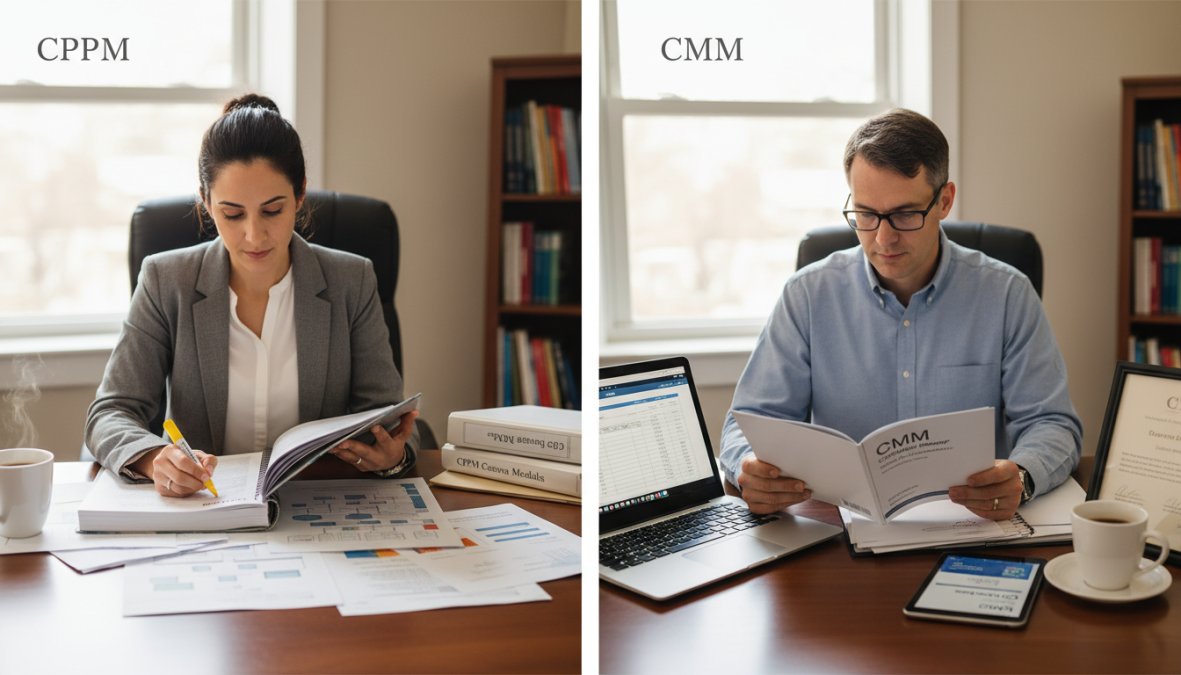
The real difference between the CPPM and CMM comes down to professional orientation. AAPC built the CPPM for administrators who work closely with billing and coding workflows, making it a natural fit for practices where the manager touches revenue cycle management daily. PAHCOM designed the CMM for broader administrative management, including human resources, healthcare policy, and practice operations at a more strategic level.
| Credential | Issuing Body | Primary Focus | Best For | Exam Format |
|---|---|---|---|---|
| CPPM | AAPC | Billing, coding, revenue cycle | Coding-adjacent managers | Multiple choice, online |
| CMM | PAHCOM | Operations, HR, compliance | Broad practice administrators | Multiple choice, proctored |
Both are accredited certifications recognized across the healthcare industry. Neither is objectively superior. The right choice depends entirely on your role, your practice type, and where you want your career to go.
Who Should Pursue the CPPM
The CPPM makes the most sense for administrators who spend meaningful time managing billing and coding staff, working with payers, or overseeing revenue cycle operations. If your day regularly involves reviewing claim denials, managing coding compliance, or interfacing with clearinghouses, the CPPM’s curriculum maps directly onto your existing knowledge base.
AAPC also offers exam vouchers through employer-sponsored programs, which makes the CPPM financially accessible for practices already invested in AAPC membership. The online exam format adds convenience for administrators who can’t easily travel to a testing center.
Who Should Pursue the CMM
PAHCOM’s CMM is the stronger credential for administrators managing solo provider practices or small group practices where the manager wears multiple hats. The CMM curriculum covers human resources, healthcare policy, compliance regulations, and patient care administration with more depth than the CPPM.
The CMM also carries strong recognition among physician-owned practices and independent clinics. If your goal is to move into a practice administrator role at a larger organization or transition into healthcare consulting, the CMM’s broader scope is an asset.
If your practice is affiliated with a hospital system or large group, ask your HR department which credential their administrators typically hold. Employer preference in your specific market often matters more than the abstract differences between the two credentials.
What the Certified Physician Practice Manager (CPPM) Exam Covers
The Certified Physician Practice Manager (CPPM) exam tests competency across eight core domains that reflect the daily operational reality of running a physician practice. AAPC designs the exam content to reflect real-world scenarios, not abstract theory.
The eight domains covered in the CPPM certification exam include:
- Healthcare business environment – payer relationships, healthcare policy, and regulatory landscape
- Revenue cycle management – charge capture, claims submission, denial management, and collections
- Billing and coding oversight – compliance with coding guidelines, audit processes, and coder supervision
- Human resources – hiring, performance management, and employment law basics
- Financial management – budgeting, accounts receivable, and practice performance metrics
- Compliance regulations – HIPAA, OSHA, and federal anti-kickback statutes
- Patient care operations – scheduling, patient flow, and quality improvement
- Information technology – EHR management and data security basics
The exam is psychometrically determined, meaning item difficulty is calibrated based on how a panel of subject matter experts rates each question. This is worth knowing because it means the exam isn’t just a memorization exercise. Questions test application and judgment, not just recall.
What most prep guides miss is that the revenue cycle management and compliance sections carry the heaviest question weighting. Allocate your study time accordingly, not evenly across all eight domains.
As documented in AAPC’s official CPPM certification overview, candidates who complete structured pre-exam training consistently outperform those who self-study exclusively.
Certified Medical Manager (CMM) Requirements and Eligibility
PAHCOM’s Certified Medical Manager credential has specific eligibility requirements that set it apart from the CPPM. The CMM is designed for working professionals with demonstrated experience in medical practice management, not entry-level candidates.
To sit for the CMM exam, candidates generally need to meet these eligibility criteria:
- A minimum number of years of experience in medical practice management (PAHCOM specifies this on their current eligibility page, and requirements are reviewed periodically)
- Current employment in a practice management role at the time of application
- Completion of PAHCOM’s pre-exam educational requirements or equivalent coursework
The CMM exam covers administrative management, human resources, financial management, healthcare policy, compliance regulations, and patient care operations. The breadth is intentional. PAHCOM positions the CMM as a credential for administrators who are accountable for the entire practice, not a single department.
One practical note: the CMM renewal cycle requires ongoing continuing education, which PAHCOM calls CEUs. Staying current matters because the credential lapses if renewal requirements aren’t met on schedule.
Medical Management Tutorial’s resources on practice management courses provide structured preparation pathways that align with CMM content domains, particularly for administrators who need to fill knowledge gaps in compliance or financial management before sitting for the exam.
Medical Practice Management Salary: What Certification Can Do for Your Pay
Salary outcomes in healthcare administration vary by geography, practice size, and specialty. Certification consistently appears as a positive variable across all three categories, though the magnitude of the effect depends on your specific market.

The honest answer is that certification alone doesn’t double your salary. What it does is remove the ceiling on your negotiating position. Non-credentialed administrators frequently hit a compensation plateau because they can’t demonstrate standardized competency to a hiring committee. Credentialed administrators have a documented benchmark that justifies higher compensation conversations.
According to MGMA’s 2025 Medical Practice Today report, practice administrators at multi-provider group practices earn substantially more than those at solo provider practices, and credentials are one of the primary differentiators within that group. Ambulatory service centers and specialty practices tend to pay the highest salaries for credentialed managers.
The practical salary impact of physician practice management certification tends to show up in three specific situations: initial job negotiations, annual reviews where you can point to a recognized professional credential, and lateral moves into larger or more complex practices.
Accepting a role without negotiating based on your credential is a common mistake. Many hiring managers start with a lower offer expecting negotiation. A CPPM or CMM credential gives you a concrete, third-party validated reason to push back on the initial number.
How to Study for Medical Management Exams: A Practical Prep Plan
Structured preparation for medical management exams follows a predictable pattern among candidates who pass on the first attempt. The approach isn’t complicated, but it requires discipline over a sustained period.
A realistic prep timeline for either the CPPM or CMM is 10 to 14 weeks of focused study. Here’s a practical framework:
Weeks 1-2: Diagnostic assessment. Take a practice exam under timed conditions before you’ve studied anything. This identifies your actual weak areas, not the ones you assume you have.
Weeks 3-8: Domain-by-domain study. Work through each content domain systematically. Spend more time on revenue cycle management and compliance regulations, as these carry the heaviest weighting on both exams.
Weeks 9-11: Integrated review. Stop studying domains in isolation and start working through mixed practice questions that require applying knowledge across multiple areas simultaneously.
Weeks 12-14: Final review and exam simulation. Complete two to three full-length timed practice exams. Review every wrong answer, not just the ones you feel uncertain about.
Medical Management Tutorial’s training resources are structured around this kind of progressive preparation, with content organized by domain and practice questions calibrated to actual exam difficulty.
Common Mistakes to Avoid When Preparing
The thing nobody tells you about medical management exam prep is that most candidates underestimate the compliance and healthcare policy sections. These feel abstract compared to billing and coding, so candidates deprioritize them. That’s a mistake that shows up in exam scores.
Three specific preparation errors to avoid:
- Studying from outdated materials: Healthcare policy and compliance regulations change. Using prep materials more than two years old creates gaps, particularly in areas like telehealth billing rules and updated HIPAA guidance.
- Skipping the practice exam phase: Reading content without testing yourself creates an illusion of competency. Practice questions reveal whether you can apply knowledge under time pressure.
- Ignoring human resources content: Both the CPPM and CMM include HR questions that many clinical administrators find unfamiliar. Employment law basics, performance management, and HR compliance are testable areas that require deliberate study.
Certification Maintenance, CEUs, and Keeping Your Credential Active
Earning a physician practice management certification is a milestone. Keeping it active is an ongoing professional responsibility that many newly certified managers underestimate until they’re approaching their renewal deadline.
Both AAPC and PAHCOM require continuing education units (CEUs) to maintain active credential status. The specific requirements differ between the two bodies, and both update their policies periodically, so checking the current requirements on the issuing body’s website is essential before planning your renewal.
What the renewal process actually looks like in practice:
- CEU tracking: Both organizations provide online portals where you log completed continuing education. Keep records of every course, webinar, or conference session as you complete it. Reconstructing your CEU history at renewal time is painful and sometimes impossible.
- Approved CEU sources: Not all continuing education counts. Courses must typically come from approved providers. AAPC-approved CEUs count toward CPPM renewal. PAHCOM has its own approved provider list for CMM renewal.
- Renewal timelines: Missing a renewal deadline typically results in a lapsed credential, which requires either a reinstatement process or retaking the exam. Neither outcome is desirable.
A practical approach is to build CEU completion into your annual professional development plan rather than scrambling in the final months before renewal. Many practice management conferences, including those affiliated with MGMA, offer sessions that qualify for CEUs under both programs.
According to PAHCOM’s official certification maintenance guidelines, credentialed members who engage in regular continuing education report higher confidence in handling emerging compliance and regulatory challenges.
The employer-sponsored certification path is worth exploring before you pay out of pocket. Many larger group practices and ambulatory service centers cover exam fees, prep course costs, and ongoing CEU expenses as part of their professional development benefits. If your employer offers this, use it. The return on that investment benefits the practice directly through better-managed operations and reduced administrative friction.
Managing a physician practice in 2026 means navigating compliance regulations, revenue cycle complexity, payer negotiations, and team leadership simultaneously. Medical Management Tutorial provides comprehensive practice management courses, billing process guidance, and administrative efficiency resources specifically designed for healthcare administrators pursuing credentials and career advancement. The platform’s structured training approach directly supports both CPPM and CMM preparation while building the operational skills that make certification meaningful in day-to-day practice management. Get started with Medical Management Tutorial and build the administrative foundation your practice needs to grow.
Frequently Asked Questions
What is a physician practice management certification?
A physician practice management certification is a professional credential that validates expertise in running a medical practice. Programs like the CPPM from AAPC and the CMM from PAHCOM cover areas including revenue cycle management, billing and coding, compliance regulations, human resources, and healthcare administration. Earning an accredited certification signals to employers and payers that you have the knowledge to manage a solo provider office, small group practice, or ambulatory service center effectively.
What is the difference between the CMM and CPPM certifications?
The CPPM, offered by AAPC, is exam-based and well-suited for professionals with a background in billing and coding who want to move into administrative management roles. The CMM, offered by PAHCOM, requires documented work experience in medical practice management and is geared toward mid-to-senior managers. Both are accredited certifications, but the CMM tends to emphasize broader operational leadership while the CPPM focuses more on the clinical and revenue cycle side of practice performance.
Do I need a degree to get a practice management certification?
Not necessarily. The CPPM certification exam from AAPC does not require a college degree, making it accessible to professionals who have built their skills through hands-on experience in healthcare administration. The CMM from PAHCOM does require documented management experience in a medical practice setting, but a specific degree is not always mandatory. Both programs offer online training resources and exam vouchers to help candidates prepare regardless of their educational background.
Is a physician practice management certification worth it for career advancement?
For most healthcare administration professionals, earning a physician practice management certification is a practical investment. Certified managers often report stronger negotiating power for salaries, greater job security, and more opportunities in larger group practices, MGMA-affiliated organizations, and ambulatory service centers. Certification also demonstrates commitment to compliance regulations and healthcare policy, which matters to employers managing complex provider and payer relationships. The return typically outweighs the cost of the certification exam and prep materials.
How long does it take to prepare for the CPPM or CMM exam?
Preparation time varies by experience level, but most candidates spend between six and twelve weeks studying for the CPPM certification exam. AAPC offers structured online training courses that guide candidates through revenue cycle management, billing and coding, and administrative management topics. For the CMM, preparation may take longer given the broader scope of the exam content. Creating a consistent weekly study schedule, using practice questions, and reviewing healthcare policy updates are all effective strategies for both exams.