


Table of Contents
- Why Medical Practice Administrative Tasks Reduction Is Urgent
- Healthcare Administrative Tasks Automation: Where to Start
- EHR Optimization to Reduce Administrative Burden in Your Practice
- AI in Healthcare Administration: Practical Tools That Deliver Results
- Outsourcing Medical Administrative Tasks: A Strategic Approach
- Staff Training and Delegation: The Overlooked Pillar of Administrative Tasks Reduction
- Common Mistakes Practices Make When Trying to Cut Administrative Work
- Conclusion
Last Updated: April 23, 2026
Medical practice administrative tasks reduction is one of the most pressing operational challenges facing clinics in 2026. According to American Medical Association’s physician burnout research, physicians now spend roughly two hours on administrative work for every hour of direct patient care. This guide from Medical Management Tutorial breaks down exactly where that time goes, which reduction strategies actually work at the practice level, and how to implement them without disrupting your clinical operations. The stakes are high: practices that fail to address this imbalance face physician burnout, revenue leakage, and declining patient experience simultaneously.
Administrative burden is not a background inefficiency. It is the central threat to sustainable medical practice in 2026.
Why Medical Practice Administrative Tasks Reduction Is Urgent
The numbers behind physician burnout are not abstract. Clinicians who spend excessive hours on documentation, prior authorization, and non-clinical tasks report significantly higher rates of emotional exhaustion than those with protected clinical time. The connection between administrative load and physician burnout is direct and well-documented by organizations including the National Academy of Medicine’s Clinician Well-Being Knowledge Hub.
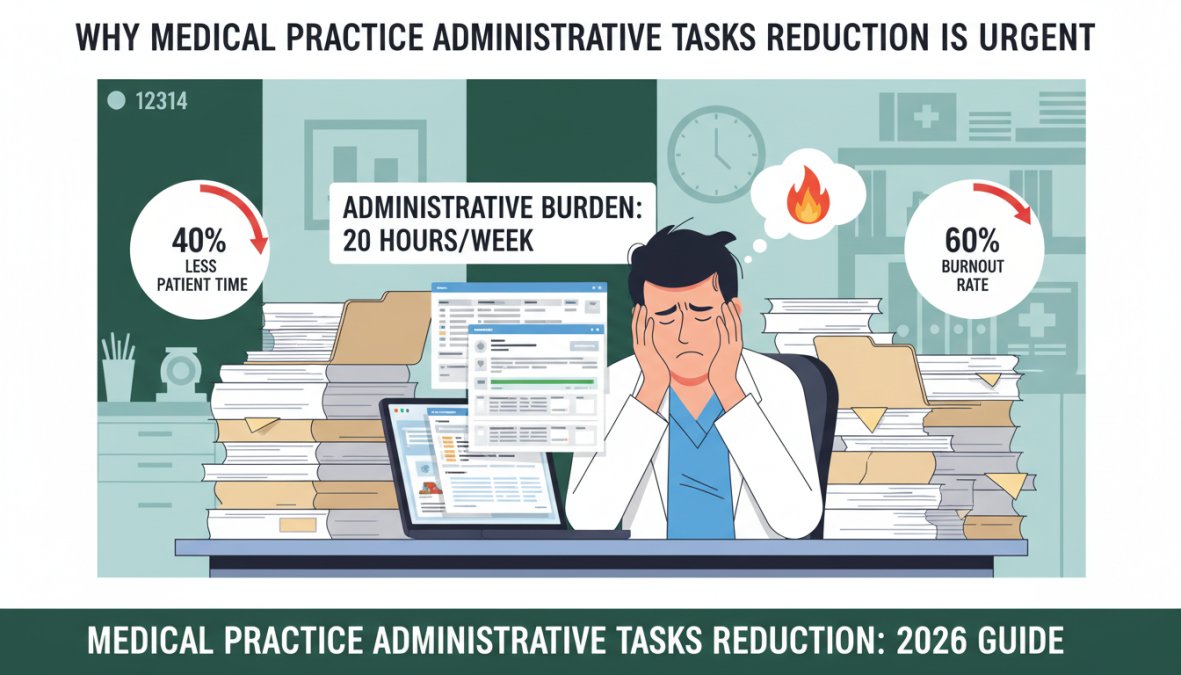
What most guides get wrong is treating burnout as a personal resilience problem. The real issue is structural: EHR documentation requirements, payer-mandated prior authorization workflows, and quality reporting obligations collectively consume time that should belong to patient care.
The Hidden Cost of Administrative Burden on Physician Burnout
Physician burnout correlates directly with cognitive load from non-clinical tasks. When a physician spends 90 minutes completing documentation after a full clinic day, the mental fatigue compounds. Over weeks and months, this pattern produces the disengagement and error risk that burnout research consistently identifies.
The hidden cost extends beyond individual wellbeing. Practices with high physician turnover face recruitment costs, temporary staffing expenses, and patient attrition. Medical practice administrative tasks reduction is therefore not just a quality-of-life issue: it is a financial health imperative.
Practices that ignore administrative burden as a burnout driver often invest in wellness programs while leaving the root cause untouched. Yoga stipends do not fix a broken prior authorization workflow. Address the structural problem first.
How Non-Clinical Tasks Undermine Patient Experience and Financial Health
Every minute a physician spends on data entry is a minute not spent on medical decision making. Patients notice when their provider seems distracted, rushed, or is typing throughout the visit rather than engaging directly. This erodes trust and reduces the likelihood of follow-through on care plans.
On the financial side, incomplete or incorrect E/M coding (Evaluation and Management) from rushed documentation produces claim denials, undercoding, and delayed reimbursements. Many practices lose meaningful revenue annually not from fraud or billing errors, but from documentation that does not accurately reflect the complexity of the visit.
Reducing administrative tasks at the practice level is the upstream fix for both problems.
Healthcare Administrative Tasks Automation: Where to Start
Most practices approach automation backwards. They purchase a new software platform, run a brief staff training, and expect results. The actual starting point for healthcare administrative tasks automation is process mapping: identifying which tasks consume the most time, which are most error-prone, and which require the least clinical judgment to complete.
A practical triage framework looks like this:
| Task Category | Automation Potential | Priority Level |
|---|---|---|
| Appointment scheduling | High | Start here |
| Insurance eligibility verification | High | Start here |
| Prior authorization requests | Medium-High | Second phase |
| Billing and claims submission | High | Second phase |
| E/M coding assistance | Medium | Third phase |
| Quality reporting data entry | High | Third phase |
Automating Billing, Scheduling, and Prior Authorization
Scheduling automation alone eliminates a substantial portion of front-desk phone volume. Online self-scheduling tools integrated with your practice management system allow patients to book, reschedule, and receive reminders without staff involvement. The downstream effect on no-show rates is real: automated reminder sequences via SMS and email consistently outperform manual phone calls.
Prior authorization is where automation delivers the most dramatic time savings. Manual prior auth processes require staff to navigate payer portals, compile clinical documentation, and follow up repeatedly. Automated prior authorization tools, integrated with your EHR, can submit requests, track status, and flag denials without manual data entry at each step.
For billing, automated claims scrubbing before submission catches CPT code errors and missing modifiers before they reach payers. This reduces denial rates and accelerates reimbursement cycles.
Before purchasing any automation tool, audit your current denial rate by denial reason. If most denials stem from eligibility issues, prioritize eligibility verification automation. If they stem from coding, prioritize coding assistance. Match the tool to the actual problem.
Using Templates and CPT Code Libraries to simplify Operations
Documentation templates are underused in most practices. A well-designed visit template for a common condition type (hypertension follow-up, annual wellness visit, post-operative check) can reduce documentation time by several minutes per encounter. Across a full clinic day, that adds up to meaningful protected time.
CPT code libraries embedded in your EHR or practice management system reduce the cognitive load of coding by surfacing the most relevant codes for a given visit type. Pairing these libraries with E/M coding guidance reduces both undercoding and overcoding risk, which directly supports medicolegal risk management.
EHR Optimization to Reduce Administrative Burden in Your Practice
EHR optimization to reduce administrative burden is not about replacing your system. It is about using what you already have more effectively. Most practices use less than half of their EHR’s available workflow features because initial implementation training was rushed and ongoing optimization never happened.
The return on investing in EHR optimization is high relative to its cost. Unlike replacing a system, which involves data migration, retraining, and significant downtime, optimization works within your existing infrastructure.
Fixing Workflow Bottlenecks Inside Your EHR System
A workflow bottleneck audit starts with time-tracking. Ask staff and clinicians to log where they spend time inside the EHR for one week. Common findings include: redundant data entry across multiple screens, manual order entry for frequently ordered tests, and lack of inbox triage protocols that leave physician inboxes unmanaged.
Specific fixes include:
- Order sets: Build condition-specific order sets for common diagnoses to eliminate repetitive individual order entry
- Inbox delegation: Configure the EHR to route non-clinical inbox items (prescription refill requests with no clinical complexity, administrative messages) to qualified staff rather than physicians
- Macro and dot-phrase libraries: Create standardized text shortcuts for frequently documented findings, reducing free-text typing time
- Encounter close checklists: Automate post-visit task reminders so nothing falls through after the patient leaves
Interoperability and Quality Reporting: Reducing Duplicate Data Entry
Duplicate data entry is one of the largest hidden time costs in medical practice. When systems do not communicate, staff manually re-enter information that already exists somewhere else in the healthcare system. Interoperability between your EHR, lab systems, imaging platforms, and payer portals directly addresses this.
Quality reporting requirements from CMS and commercial payers add another layer of documentation burden. Practices participating in value-based care programs often find that data required for quality measures is already captured in the EHR but must be manually extracted and reported. Automated quality reporting modules eliminate this step.
According to Office of the National Coordinator for Health Information Technology, improving health information exchange and interoperability is a national priority precisely because fragmented data systems drive administrative burden across the healthcare system.
AI in Healthcare Administration: Practical Tools That Deliver Results
AI in healthcare administration has moved well past the hype phase. Specific, narrow AI applications are delivering measurable results in practices that have deployed them thoughtfully.

The most proven AI applications in practice administration include:
- Ambient clinical documentation: AI listens to the patient-physician encounter and generates a structured clinical note draft. The physician reviews and approves rather than composing from scratch. This is the single highest-impact AI application for physician time savings currently available.
- AI-assisted prior authorization: Predicts authorization likelihood based on payer history and surfaces supporting clinical documentation automatically.
- Intelligent scheduling optimization: Fills cancellation slots in real time, balances provider schedules, and reduces gaps that cost practices revenue.
- Automated coding suggestions: Reviews encounter documentation and suggests appropriate CPT codes and ICD-10 codes, reducing coder review time.
- Chatbot-based patient intake: Collects history, medication lists, and reason for visit before the encounter, reducing time spent on intake during the visit itself.
The thing nobody tells you about AI tools in healthcare is that the implementation phase determines whether they succeed or fail. A tool that generates ambient notes but requires 10 minutes of physician correction per note has not solved the problem. Pilot with a small group of willing clinicians, measure actual time savings, and only expand when the data supports it.
Medical Management Tutorial’s resources on practice management software provide detailed guidance on evaluating AI tools against your specific workflow needs, helping practices avoid the common mistake of purchasing technology without a clear implementation plan.
AI in healthcare administration works best as a narrow, targeted intervention, not a platform replacement. Start with ambient documentation or prior authorization automation, measure the time impact over 60 days, then decide whether to expand.
Outsourcing Medical Administrative Tasks: A Strategic Approach
Outsourcing medical administrative tasks is a legitimate strategy for practices that lack the internal capacity to manage certain functions efficiently. The decision is not binary between full in-house and full outsourcing. The most effective approach is selective outsourcing based on task complexity, volume, and the availability of qualified internal staff.
According to Medical Group Management Association’s operational benchmarking resources, practices that outsource revenue cycle management functions often see improvements in collection rates and reductions in days in accounts receivable. The caveat: outsourcing works when the vendor has deep healthcare-specific expertise and clear contractual accountability for performance metrics.
Which Tasks to Delegate vs. Keep In-House
The delegation decision framework comes down to three criteria: clinical judgment required, patient relationship sensitivity, and volume relative to internal capacity.
Tasks well-suited for outsourcing or delegation:
- Medical billing and claims follow-up
- Insurance eligibility verification
- Medical transcription and documentation support
- Credentialing and provider enrollment
- After-hours answering services
Tasks that should stay in-house:
- Clinical triage decisions
- Patient communication requiring clinical context
- Compliance and HIPAA oversight
- Vendor relationship management
- Quality reporting oversight
A common mistake is outsourcing tasks without establishing clear performance benchmarks upfront. Define what success looks like before signing a contract: denial rate targets, turnaround time standards, and escalation protocols for complex cases.
Staff Training and Delegation: The Overlooked Pillar of Administrative Tasks Reduction
Here is where most practice improvement plans fall short. Practices invest in new technology, optimize their EHR, and even outsource billing, but neglect to build the internal staff capability that makes all of it work.
Staff productivity in medical practice administration is not just about how fast tasks get done. It is about whether the right person is doing the right task. Physicians performing tasks that a trained medical assistant or administrative coordinator could handle represents one of the most expensive and common inefficiencies in practice operations.
Effective delegation requires:
- Role clarity: Every administrative task should have a designated owner. Ambiguity about who handles prior authorization follow-up, for example, leads to tasks falling through or being duplicated.
- Cross-training: Staff who can cover multiple administrative functions reduce single points of failure when someone is absent.
- Ongoing EHR training: Most EHR vendors release feature updates regularly. Practices that do not schedule periodic training miss efficiency gains that are already available to them.
- Protocol documentation: Written workflows for common tasks reduce variability, training time, and error rates.
Medical Management Tutorial’s practice management courses address staff training and delegation directly, providing structured frameworks for building administrative team competency that supports both physician workflow and patient flow.
The return on training investment is high. Staff who understand the full administrative cycle, from scheduling through billing, make better real-time decisions and require less physician oversight for routine tasks.
Common Mistakes Practices Make When Trying to Cut Administrative Work
Avoiding these mistakes is as important as implementing the right strategies. Medical practice administrative tasks reduction efforts fail more often from execution errors than from choosing the wrong tools.
1. Solving the wrong problem first. Practices often automate a low-volume task while ignoring a high-volume bottleneck. Map your administrative time before purchasing any solution.
2. Underestimating change management. New workflows fail when staff do not understand why the change is happening. Communicate the rationale, involve frontline staff in the design, and expect a 60-90 day adjustment period.
3. Purchasing technology without a workflow redesign. Software does not fix a broken process. It accelerates it, for better or worse. Redesign the workflow first, then identify the technology that supports it.
4. Neglecting medicolegal risk in documentation shortcuts. Templates and macros speed up documentation but can introduce medicolegal risk if they produce notes that do not accurately reflect the actual encounter. Every template needs a clinical review before deployment.
5. Measuring the wrong outcomes. Many practices track whether they implemented a new tool, not whether it reduced administrative time. Measure physician documentation time per encounter, denial rates, and staff time per task before and after any intervention.
Using documentation templates without customization for individual patient encounters creates medicolegal exposure. A note that reads identically for two different patients with different presentations is a liability. Templates should be starting points, not finished products.
6. Failing to involve physicians in the design process. Administrators often design administrative workflows without physician input, then wonder why adoption is low. Physicians are the end users of documentation and EHR workflows. Their input is not optional.
The practices that achieve sustained medical practice administrative tasks reduction share one characteristic: they treat it as an ongoing operational discipline, not a one-time project. Regular audits, staff feedback loops, and technology reassessments keep the gains from eroding over time.
Administrative burden will not solve itself, and the cost of inaction compounds every year. Medical Management Tutorial provides the practice management courses, software guidance, and operational frameworks that help clinics build durable administrative efficiency. The platform’s resources cover EHR optimization, billing process improvement, and staff training strategies that translate directly into reduced physician administrative load and stronger practice financial health. Get started with Medical Management Tutorial and build the administrative infrastructure your practice needs to protect both clinical quality and long-term growth.
Frequently Asked Questions
What are common examples of administrative burden in a medical practice?
Common examples include manual prior authorization requests, repetitive data entry into EHR systems, E/M coding and CPT code documentation, quality reporting submissions, insurance verification, and managing billing and scheduling. These non-clinical tasks consume significant clinician time, increase cognitive load, and directly contribute to physician burnout while reducing time available for patient care and meaningful medical decision making.
How does healthcare administrative tasks automation actually work in practice?
Healthcare administrative tasks automation typically uses software to handle repetitive workflows like appointment reminders, insurance eligibility checks, prior authorization submissions, and billing follow-ups. Practices integrate automation tools with their existing EHR platform to trigger actions based on rules, for example, automatically sending a patient intake form after booking. Starting with one high-volume task, such as scheduling, allows teams to measure impact before expanding automation across other workflows.
Is outsourcing medical administrative tasks cost-effective for small practices?
Outsourcing medical administrative tasks can be cost-effective even for small practices when the right tasks are delegated. Billing, coding, prior authorization follow-up, and telehealth support are strong candidates. Rather than hiring full-time staff, outsourcing converts fixed labor costs into variable ones. The key is calculating the revenue recovered from fewer claim denials and faster reimbursements against the outsourcing fee, many practices find the net gain outweighs the cost within a few months.
What is the single most effective change to reduce administrative burden for doctors?
Optimizing EHR workflows tends to have the broadest impact on medical practice administrative tasks reduction. Most physicians spend significant time on documentation, and reconfiguring note templates, enabling smart text shortcuts, and setting up condition-specific order sets can cut documentation time substantially. Pairing EHR optimization with scribes or AI-assisted ambient documentation tools amplifies the effect, freeing clinicians to focus on medical decision making and direct patient care rather than data entry.
How can medical assistants and support staff help reduce administrative burden?
Medical assistants can take on delegation-ready tasks such as pre-visit documentation, medication reconciliation, prior authorization initiation, and patient follow-up calls. Training staff to handle E/M coding support, manage referral workflows, and use practice management software effectively reduces the cognitive load on physicians. Structured delegation protocols, where each team member has a clearly defined role in the workflow, are the foundation of sustainable administrative tasks reduction at the practice level.