

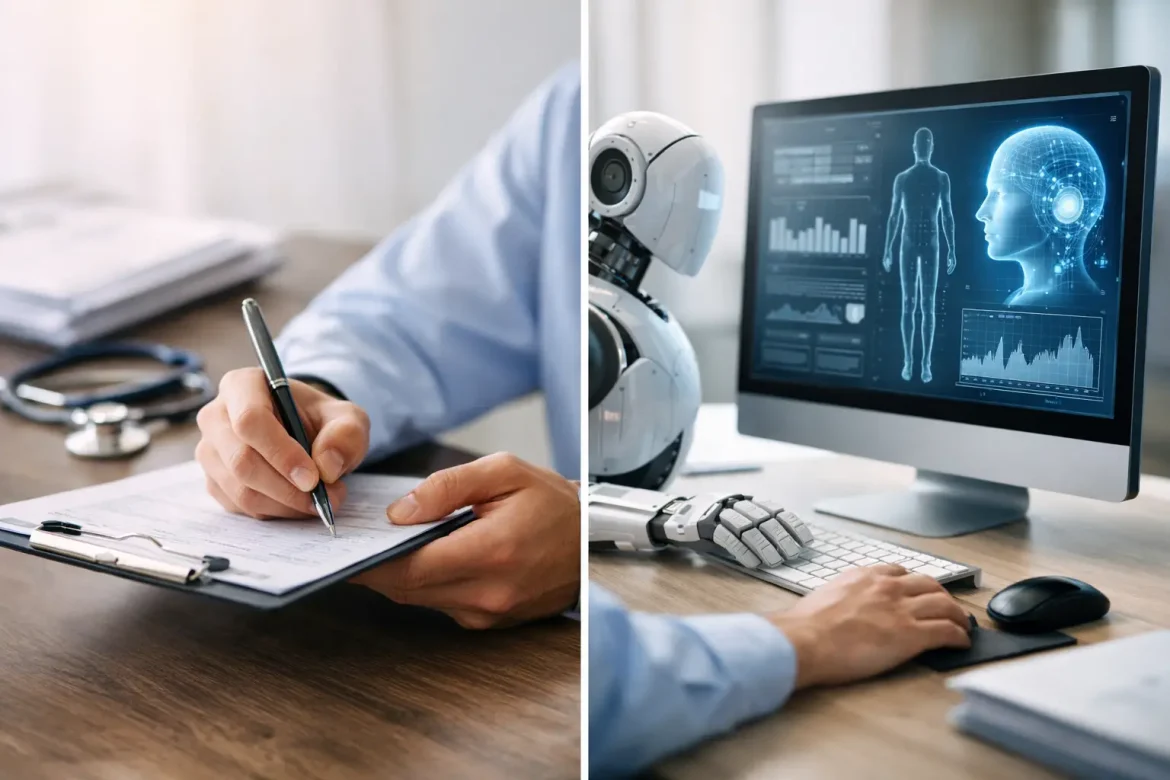
A physician finishes the last patient of the day, then spends another 90 minutes catching up on notes. That gap between care delivered and care documented is exactly why manual charting vs AI documentation has become a serious operational question for practices, not just a technology trend. The real issue is not whether AI sounds impressive. It is whether documentation gets faster, cleaner, and safer without weakening clinical judgment.
For most medical practices, documentation is both a clinical record and a business process. It affects coding, compliance, staff workload, claim quality, patient communication, and physician burnout. That is why the right comparison is not old versus new. It is which method supports quality care while fitting the realities of your workflow.
Manual charting vs AI documentation: what actually changes
Manual charting gives the clinician direct control over every word entered into the record. Whether typed after the visit or documented during the encounter, the note reflects the physician’s own structure, language, and sequencing. Many clinicians trust this approach because it feels precise and familiar. It can also be more reliable for complex cases where nuance matters and the physician wants to emphasize specific reasoning.
AI documentation changes the process by using ambient listening, speech recognition, structured prompts, or draft generation to produce a clinical note. In practice, the physician still reviews and signs the chart, but the first draft is created with automation. That shift matters because the time-consuming part of documentation is often not the final clinical judgment. It is the repetitive assembly of history, assessment language, and standard encounter elements.
The main benefit of AI is speed. The main risk is overtrust.
That tension should guide every adoption decision.
Where manual charting still has a clear advantage
Manual charting is often stronger when the encounter is clinically complicated, emotionally sensitive, or legally high risk. A physician documenting a difficult differential diagnosis, a poor prognosis discussion, or a disputed symptom history may prefer complete manual control. In these moments, wording is not just administrative. It can shape continuity of care, referral quality, and legal defensibility.
Manual workflows can also work well in smaller practices where clinicians have already built efficient templates and shorthand into the EHR. If a physician sees a relatively predictable case mix and documents quickly with strong habits, the benefit of AI may be smaller than expected. Not every practice has the same pain point.
There is also a training advantage. Manual charting forces clinicians to organize the encounter in their own mind. For residents, new attendings, and clinicians refining their assessment style, that discipline has value. It helps sharpen clinical reasoning rather than outsourcing structure too early.
Still, the cost is obvious. Manual charting consumes physician time, extends the workday, and often shifts documentation into evenings. Once charting becomes after-hours work, it is no longer just a preference. It becomes an operational liability.
Where AI documentation delivers real value
AI documentation performs best when the documentation burden is repetitive, high volume, and structurally predictable. Primary care, urgent care, multispecialty clinics, and many outpatient settings fit this pattern. In these environments, a well-designed AI tool can reduce note time, improve consistency, and allow physicians to spend more attention on the patient rather than the keyboard.
The productivity gain is only part of the story. AI can also help standardize documentation quality across providers. That matters for group practices trying to improve coding support, referral clarity, and chart completeness. If one physician writes concise, structured notes and another produces sparse or inconsistent documentation, downstream operations suffer. AI can narrow that gap if the review process is strong.
There is a communication benefit as well. Many clinicians feel that typing during visits weakens eye contact and patient connection. Ambient AI tools can reduce that visual barrier. Patients often notice when the physician is more present. In a practice environment where experience matters, that is not a small advantage.
But none of this means AI notes are ready to file without review. They are drafts, not decisions.
The biggest mistake in manual charting vs AI documentation
The biggest mistake is treating the comparison as a simple choice between accuracy and efficiency. In reality, both methods can be accurate and both can create errors.
Manual charting errors often come from fatigue, copying forward outdated language, incomplete details, or delayed memory. AI documentation errors often come from misheard statements, incorrect summarization, invented details, or subtle distortion of medical reasoning. One method fails from human overload. The other can fail from automation bias.
That is why the better question is this: where is error most likely to occur in your practice, and which safeguards can realistically be maintained every day?
A strong physician reviewer can catch most AI note problems. A rushed physician at 7:30 p.m. may miss them. Likewise, a disciplined clinician can produce excellent manual notes, while an exhausted one may chart too little or too late. The system around the clinician matters as much as the tool.
How to evaluate AI documentation in a medical practice
If you are considering a shift away from fully manual charting, the best approach is operational, not ideological. Start by measuring current documentation pain. Look at after-hours charting, average note completion time, provider variation, claim issues tied to documentation, and physician satisfaction. Without a baseline, it is hard to judge whether AI is helping.
Next, review workflow fit. An AI tool may perform well in demos and poorly in a noisy clinic or specialty-specific encounter. Consider how it handles accents, multiple speakers, medical terminology, specialty vocabulary, and your existing EHR habits. A documentation tool that creates extra editing work is not saving time.
Privacy and compliance review should come early, not late. Healthcare leaders need clarity on consent workflows, data storage, transcription handling, auditability, and how protected health information moves through the system. The convenience of AI does not remove your responsibility for governance.
Then test with a controlled pilot. A small physician group, a defined period, and clear metrics will tell you more than broad enthusiasm. Measure note turnaround time, edit burden, physician trust, patient reaction, and documentation quality. Ask not only whether notes are faster, but whether clinicians feel more or less mentally taxed by reviewing them.
A practical middle ground often works best
For many practices, the best answer in manual charting vs AI documentation is not either-or. It is selective use.
Some clinicians may use AI to draft history and routine assessment language, then manually refine impression and plan. Others may rely on AI for follow-up visits but prefer manual charting for new patient consultations, behavioral health conversations, or medically complex cases. This kind of hybrid model respects both efficiency and risk.
Practice leaders should not force uniform adoption too quickly. Documentation style is closely tied to physician confidence and workflow comfort. A tool that one provider finds liberating may feel distracting to another. The goal is standardization where it improves quality, not standardization for its own sake.
Training also matters more than many vendors admit. Physicians need guidance on how to review AI notes, what errors to watch for, and when to reject auto-generated phrasing. Staff need clear expectations around patient communication, room setup, and consent language if ambient listening is used. Good implementation is less about the software alone and more about clinical governance.
What practice owners and administrators should watch
If you lead a clinic, the documentation decision should be tied to measurable outcomes. Watch physician overtime, chart closure lag, coding consistency, patient satisfaction, and provider retention. Burnout reduction is valuable, but it should not come at the cost of weaker documentation standards.
Also watch for false efficiency. A note produced in 30 seconds is not efficient if it requires three minutes of corrections or creates downstream billing confusion. The best documentation process reduces total friction across the practice, not just physician typing time.
This is where a pragmatic management lens matters. Medical Management & ΕΠΙΚΟΙΝΩΝΙΑ regularly covers the point where clinical workflows and business performance meet, and documentation is a clear example. The note is not just a record of care. It drives operations.
The better question is not which is better
Manual charting is not obsolete. AI documentation is not automatically superior. Each method reflects a different trade-off between control, speed, cognitive load, and review responsibility.
If your clinicians are drowning in after-hours charting, AI deserves serious consideration. If your specialty requires highly nuanced documentation and your team already charts efficiently, manual processes may still be appropriate. Most practices will land somewhere in the middle, using AI where it reduces friction and relying on clinician-written precision where nuance carries more risk.
The useful standard is simple: choose the documentation model that protects clinical quality, supports patient trust, and gives your team time back without asking them to lower their guard.