

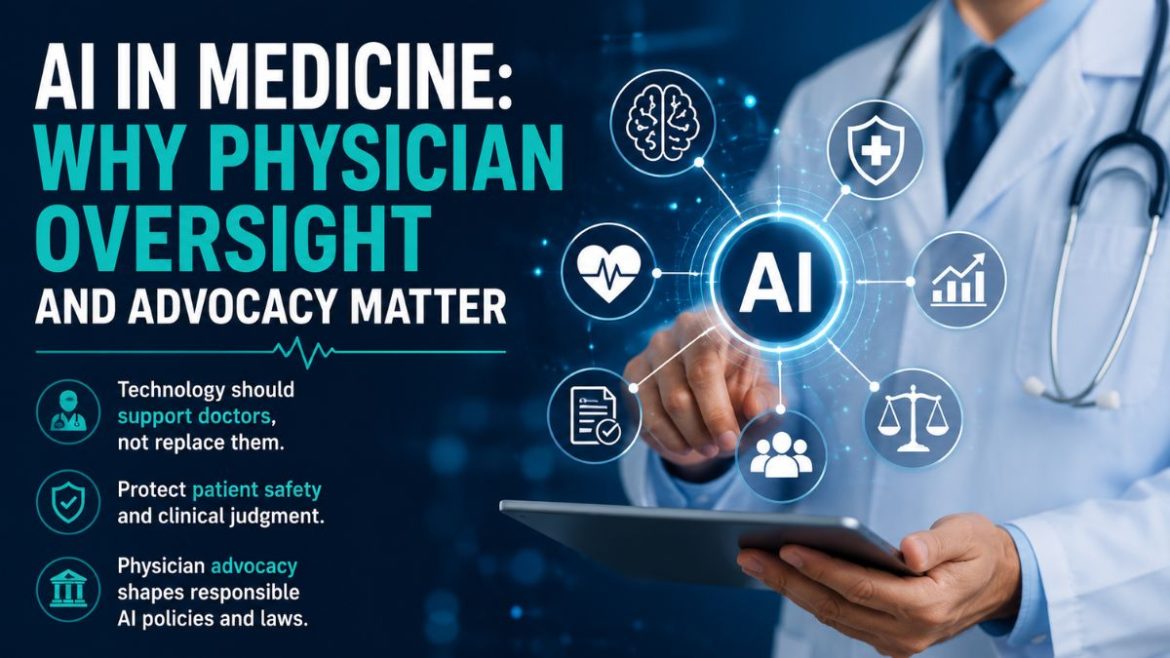
Artificial intelligence is rapidly moving from experimentation into everyday healthcare. AI-powered tools are already being used to support clinical documentation, diagnostic imaging, workflow management and patient monitoring, creating opportunities to improve efficiency and reduce some of the administrative burden placed on physicians.
At the same time, their growing role raises important questions about clinical responsibility, transparency, patient safety and the future of the patient-physician relationship.
The key issue is therefore not whether AI should have a place in medicine, but how it should be integrated into clinical practice and where human oversight must remain essential.
For physicians, this makes active participation increasingly important—not only when selecting and using AI tools, but also in shaping the policies and standards that govern them.
AI can reduce the administrative burden on physicians
One of the most immediately useful applications of AI is not necessarily diagnosis, but operational efficiency.
Clinical documentation is a good example. AI-enabled ambient documentation systems can capture elements of the patient encounter and generate draft clinical notes or other structured information for review.
Used appropriately, these technologies may reduce the time physicians spend documenting encounters and allow them to devote greater attention to the patient during consultations.
This is particularly relevant in an environment where administrative workload contributes significantly to professional pressure and physician burnout.
AI is also being explored for operational functions such as:
- Appointment scheduling
- Workflow optimization
- Prediction of missed appointments
- Resource allocation
- Identification of periods of increased demand
- Administrative documentation
In these applications, AI can function primarily as a support tool, automating repetitive tasks while allowing healthcare professionals to focus on activities that require clinical expertise and human interaction.
From workflow support to clinical decision support
The implications become more complex when AI begins contributing directly to clinical assessment.
In radiology, AI systems can support image interpretation by identifying patterns or abnormalities that warrant further attention. Similar applications are emerging in dermatology, where algorithms can assist in the assessment of skin lesions and other abnormalities.
AI may also support continuous monitoring, including situations in which changes in a patient’s condition need to be identified between direct clinical assessments.
These applications demonstrate one of AI’s most important potential roles in medicine: augmenting human capabilities.
However, there is an important distinction between supporting a physician’s decision and making that decision independently.
As AI becomes more deeply integrated into clinical workflows, maintaining that distinction becomes increasingly important.
The “black box” problem creates a challenge for medicine
Some sophisticated AI systems can generate outputs without providing an easily understandable explanation of how they reached their conclusions.
This is commonly referred to as the black box problem.
In healthcare, lack of transparency is particularly important because clinical decisions can have significant consequences.
If an AI system recommends a particular course of action, physicians may need to understand:
- What information influenced the recommendation?
- How reliable is the model for this particular patient population?
- What are its known limitations?
- Could important clinical information have been overlooked?
- How should conflicting clinical evidence be interpreted?
If these questions cannot be adequately answered, incorporating the output into clinical decision-making becomes more difficult.
Transparency also matters for communication with patients. Physicians need to be able to discuss the basis, limitations and uncertainties surrounding recommendations that influence care.
Automation bias is another important risk
AI systems do not need to make decisions autonomously to influence medical judgment.
Automation bias occurs when people place excessive confidence in recommendations generated by automated systems, potentially reducing their own critical evaluation of the information.
For example, an AI-generated clinical note may appear complete and professionally written while still containing an incorrect detail, omission or interpretation.
If the physician approves the note without carefully reviewing it, that information can become part of the patient’s medical record.
The same principle applies to diagnostic suggestions and other forms of clinical decision support.
The more accurate AI becomes in routine situations, the easier it may become for users to assume that its outputs are consistently correct. This makes professional oversight more—not less—important.
AI-generated documentation still requires physician review
Clinical documentation has implications that extend beyond administrative efficiency.
The medical record supports continuity of care, communicates information among healthcare professionals and documents the clinical reasoning and actions associated with an encounter.
For this reason, physicians using AI-generated documentation should treat it as a draft requiring professional verification, rather than as an automatically reliable final record.
The clinician remains responsible for ensuring that the documentation accurately reflects the encounter before it becomes part of the patient’s record.
Saving time through automation has value only if efficiency does not compromise accuracy.
Clinical judgment should remain central
AI can process enormous amounts of information and identify patterns that may be difficult for humans to detect. What it does not possess is the complete professional relationship and contextual understanding that exists between physician and patient.
Clinical decisions may involve factors that are difficult to capture in structured data, including:
- Patient preferences
- Previous treatment experiences
- Multiple concurrent conditions
- Social circumstances
- Individual risk tolerance
- Quality-of-life priorities
- Subtle findings from direct clinical assessment
The physician’s role therefore extends beyond interpreting data.
Medical judgment requires integrating scientific evidence with the individual circumstances of the person receiving care.
AI can contribute information to that process, but its output should not automatically become the decision itself.
Physicians should have a voice in selecting AI tools
As healthcare organizations adopt AI technologies, physicians should be involved in their evaluation and implementation.
Clinical users are well positioned to identify questions that may not be obvious during a purely technical assessment:
- Does the tool address a genuine clinical or operational need?
- Has it been adequately validated?
- For which patient populations was it developed?
- What are its known limitations?
- How does it integrate into the existing workflow?
- Can clinicians question or override its recommendations?
- How are errors identified and reported?
- What happens when the system and the physician disagree?
Introducing an AI system without meaningful clinical input risks creating workflows that are technologically sophisticated but poorly suited to real-world care.
Physician advocacy matters beyond the hospital or practice
The rapid development of AI also means that many important decisions will be made outside individual healthcare organizations.
Regulators, policymakers, professional organizations, insurers and technology developers will influence how these systems are used and who bears responsibility when something goes wrong.
Physicians therefore have an important role in broader discussions about AI governance.
Areas requiring particular attention include the preservation of physician clinical judgment and appropriate safeguards against the use of automated systems in ways that could interfere with medically necessary care.
Physician involvement can help ensure that policy reflects the realities of clinical practice rather than being shaped solely by technological or administrative considerations.
Medical liability needs clear boundaries
AI also raises difficult questions about accountability.
If a physician follows an incorrect AI recommendation, where does responsibility lie? What if an algorithm contains a design flaw that was not apparent to its clinical user? What level of independent verification should reasonably be expected from the physician?
These questions become increasingly important as AI systems move closer to clinical decision-making.
Clear frameworks are needed to distinguish responsibility among clinicians, healthcare organizations, technology developers and other parties involved in deploying AI.
Without such clarity, physicians may face uncertainty about their obligations when using tools that they did not design and whose internal decision-making may not be fully transparent.
AI creates new risks beyond clinical decisions
The challenges are not limited to diagnosis or documentation.
Generative AI can also be used to create convincing false images, audio or video. For physicians, this introduces risks involving impersonation and the unauthorized use of professional identity.
A fabricated video appearing to show a physician promoting a treatment, product or medical claim could potentially damage professional reputation while also misleading patients.
Protecting physicians and patients from such misuse will require technical safeguards, clear institutional procedures and appropriate legal frameworks.
Professional organizations can strengthen the physician voice
Individual physicians may have limited influence over national or regional AI policy. Collective professional representation can provide a stronger mechanism for engagement.
Medical societies and professional associations can contribute by:
- Evaluating emerging policy proposals
- Communicating clinical concerns to policymakers
- Developing professional guidance
- Supporting physician education
- Advocating for appropriate safeguards
- Representing physicians in discussions about liability and regulation
This collective participation becomes particularly important when technological development moves faster than traditional regulatory processes.
Physicians also need AI literacy
Effective oversight requires more than simply insisting that a human remains involved.
Physicians need enough understanding of AI to evaluate its strengths and limitations critically.
This does not mean clinicians need to become data scientists or software engineers. However, they should increasingly understand concepts such as:
- Algorithmic bias
- Validation
- Data quality
- Automation bias
- Model limitations
- Transparency
- Privacy and security
- Appropriate human oversight
Without this knowledge, meaningful supervision becomes difficult.
AI literacy should therefore increasingly be considered part of professional development as these technologies become more common in clinical environments.
The goal is augmentation, not automatic substitution
Artificial intelligence has significant potential to reduce administrative burden, support diagnostic processes, improve workflows and provide clinicians with additional information.
Its value, however, depends heavily on how it is implemented.
Healthcare organizations should avoid framing the discussion as a competition between physicians and technology. The more useful question is how AI can support clinicians while preserving the professional judgment, accountability and human relationships on which medicine depends.
Physicians have a central role in achieving that balance.
By remaining informed, critically reviewing AI-generated outputs, participating in technology evaluation and contributing to policy discussions, the medical profession can help shape an environment in which AI complements clinical expertise rather than substitutes for it.