

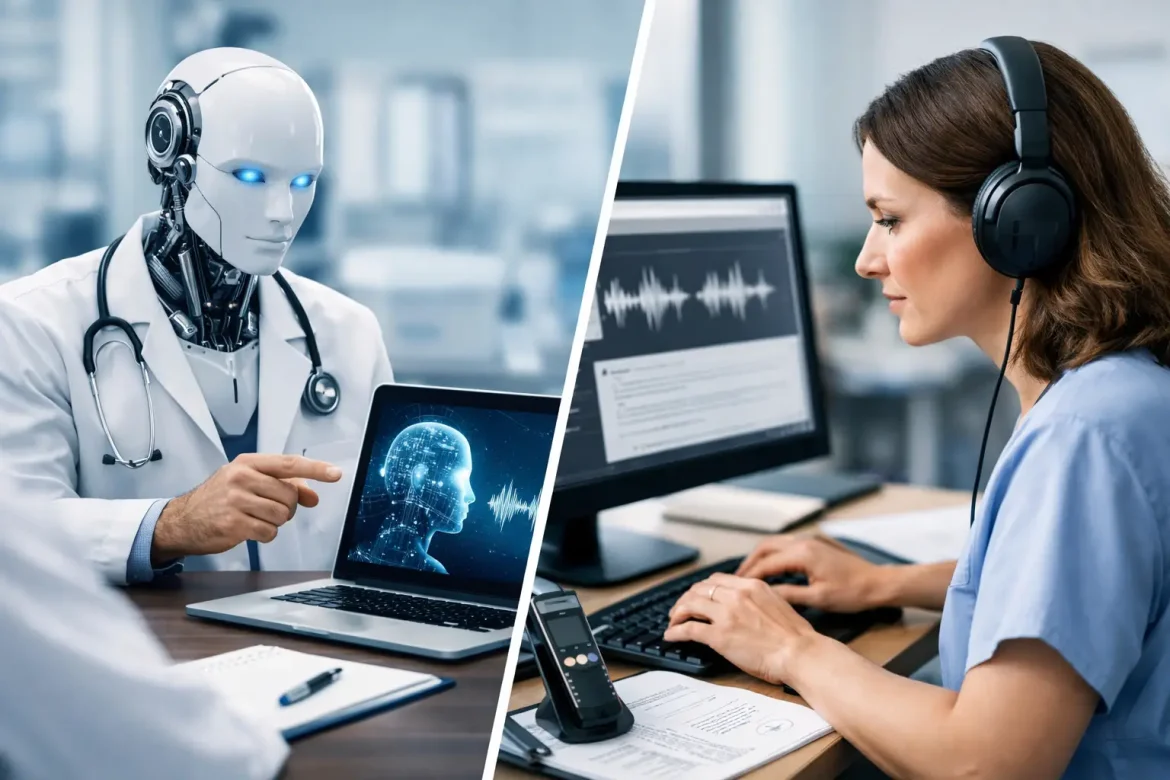
A physician finishes a complex follow-up visit, then faces a familiar choice: dictate notes for later typing, stay late to document, or try an AI tool that promises to write the chart during the encounter. That is where the real question of ai scribes vs medical transcription starts – not with technology hype, but with workflow pressure, documentation quality, and the daily economics of running a practice.
For most medical groups, this is not a simple replacement decision. AI scribes and medical transcription solve different parts of the documentation problem. One aims to capture and structure the clinical conversation in near real time. The other turns dictated audio into text after the clinician has already decided what to say and how to say it. If your goal is fewer after-hours notes, more patient attention, and better operational efficiency, the distinction matters.
AI scribes vs medical transcription: the core difference
Medical transcription is a familiar model. The clinician dictates a note, either immediately after the visit or later, and a transcriptionist or transcription platform converts that audio into text. The workflow begins after the physician has done the cognitive work of summarizing the encounter. In many practices, the final result still needs editing, formatting, and EHR placement.
AI scribes work earlier in the process. They listen to the visit, identify clinically relevant details, and generate structured documentation such as SOAP notes, HPI, assessment, or patient instructions. The physician still reviews and approves the note, but the draft is created from the live interaction rather than from separate dictation.
That timing difference changes everything. Transcription helps convert speech to text. AI scribes aim to reduce the need to recreate the visit after it ends.
Where medical transcription still works well
Medical transcription remains useful in settings where physicians prefer high control over the wording of the note. Specialists with nuanced reporting styles, surgeons dictating operative details, and clinicians who think clearly through post-visit dictation often do well with transcription. It is also a practical option when visits are short, structured, and not heavily conversational.
There is another advantage: dictation can be more deliberate than ambient capture. If a physician wants to exclude side conversations, simplify the record, or present findings in a very specific sequence, transcription may feel safer and more predictable. In that model, the clinician remains the primary author, and the transcription process is largely clerical.
The trade-off is time. The doctor still has to dictate. If dictation happens at the end of the day, documentation bottlenecks remain. If transcription turnaround is delayed, chart completion can lag behind billing and care coordination.
Where AI scribes change the workflow
AI scribes are appealing because they target the hidden labor around documentation. Instead of asking the physician to remember, summarize, and dictate after each encounter, the system creates a draft from the actual visit. For many outpatient practices, that can mean less pajama time, faster note completion, and a more natural patient interaction.
This is especially valuable in primary care, behavioral health, and other settings where the conversation itself contains the note. When the patient history, counseling, treatment discussion, and follow-up plan are all spoken in the room, an AI scribe can capture more context than a short end-of-visit dictation.
But there is a caution here. AI scribes do not remove clinician responsibility. They can misattribute statements, overstate findings, omit subtle negatives, or produce polished language that sounds correct without being fully accurate. In other words, they save time only if your review process is disciplined.
Accuracy is not one category
When practices compare ai scribes vs medical transcription, they often ask which one is more accurate. That is the right question, but it needs to be split into two parts.
Transcription accuracy usually means whether dictated words were converted correctly into text. If the physician says it clearly, the transcription may be highly reliable. The main errors are often audio quality, accents, medication names, or formatting issues.
AI scribe accuracy is broader. The system must identify who said what, determine which details are clinically relevant, organize them into a note, and often infer structure from a messy real-world conversation. It is not just converting language. It is interpreting context. That makes AI scribes more powerful, but also introduces a different risk profile.
For this reason, practices should not evaluate either tool with generic claims. Review sample notes from your own specialty, your own visit length, and your own documentation standards. A dermatology follow-up, a psychiatric intake, and an orthopedic consultation place very different demands on any documentation system.
Cost is more than subscription price
Many buyers compare vendor fees and stop there. That is understandable, but incomplete.
Medical transcription costs may be charged per line, per minute, or through staffing arrangements. Those costs can look straightforward, especially for low-volume practices. Yet the hidden expense is physician time spent dictating and editing, plus any delay in finalizing the chart.
AI scribes often come with a software subscription that appears higher at first glance. However, if they reduce documentation time, improve same-day chart closure, and support faster claim completion, the operational return may be better than the sticker price suggests.
This does not mean AI scribes are always cheaper. In some specialties with brief, repetitive notes, transcription may still be the more economical choice. In others, especially where clinician burnout and after-hours charting are significant, the real savings come from recovered physician capacity.
Compliance and patient trust need active management
Both models raise privacy and compliance considerations, but in different ways.
With transcription, the main issues usually involve secure dictation workflows, protected health information handling, and vendor safeguards. The process is established, and many practices already understand the controls needed.
AI scribes require closer scrutiny because they may record or process live patient conversations, integrate directly with the EHR, and use large language models to generate note content. That means decision-makers should ask practical questions about consent, data storage, retention policies, human review, audit trails, and whether protected data is used for model training.
Patient communication matters here too. Some patients are comfortable with ambient documentation if it helps the physician stay engaged. Others may feel hesitant, especially during sensitive visits. Your front-desk script, consent language, and in-room explanation should be clear and calm. Technology adoption fails quickly when patients feel they are being recorded without understanding why.
How to choose for your practice
The best decision usually comes down to workflow design, not novelty.
Choose medical transcription if your physicians strongly prefer dictation, your note style depends on deliberate summary after the encounter, or your specialty requires highly customized narrative reporting. It is also a reasonable choice if your current process is working and the main goal is dependable text conversion rather than major workflow redesign.
Choose AI scribes if your clinicians are struggling with documentation burden, your visits are conversation-heavy, and your leadership is prepared to implement clear review standards. AI scribes make the most sense when the practice wants to reduce after-hours charting and support more direct attention during the encounter.
Some groups will benefit from a hybrid model. For example, an AI scribe may work well for routine office visits, while transcription remains better for complex procedures or physician-specific reports. A mixed approach is often more realistic than an all-or-nothing rollout.
What to test before you commit
Before signing a long contract, pilot the system with a small set of clinicians and measure real outcomes. Look at chart closure time, edit burden, physician satisfaction, note quality, and impact on patient interaction. Also watch for a less obvious issue: whether clinicians start trusting drafts too quickly and reduce their own review discipline.
It helps to define success in operational terms. Are notes signed the same day? Are coding elements captured more consistently? Are physicians spending less time documenting after clinic hours? Are patients noticing better eye contact and communication? These are stronger indicators than a vendor demo.
For an audience like the one served by Medical Management & ΕΠΙΚΟΙΝΩΝΙΑ, the practical lesson is simple: documentation technology should improve clinical work, not just change it. A tool that produces elegant notes but creates compliance concerns, editing fatigue, or patient discomfort is not an upgrade.
The right choice is the one that fits how your clinicians actually practice, how your patients experience the visit, and how your business measures efficiency. If you evaluate both options through that lens, the decision becomes less about trend and more about operational fit. That is usually where the best technology decisions are made.